
Unlock the secrets of successful digital marketing with our in-depth guide on Facebook ads for insurance agents! Discover how to maximize your ROI and turn potential leads into loyal clients through targeted strategies and best practices. Don't miss out on the insights that could transform your agency's advertising game!
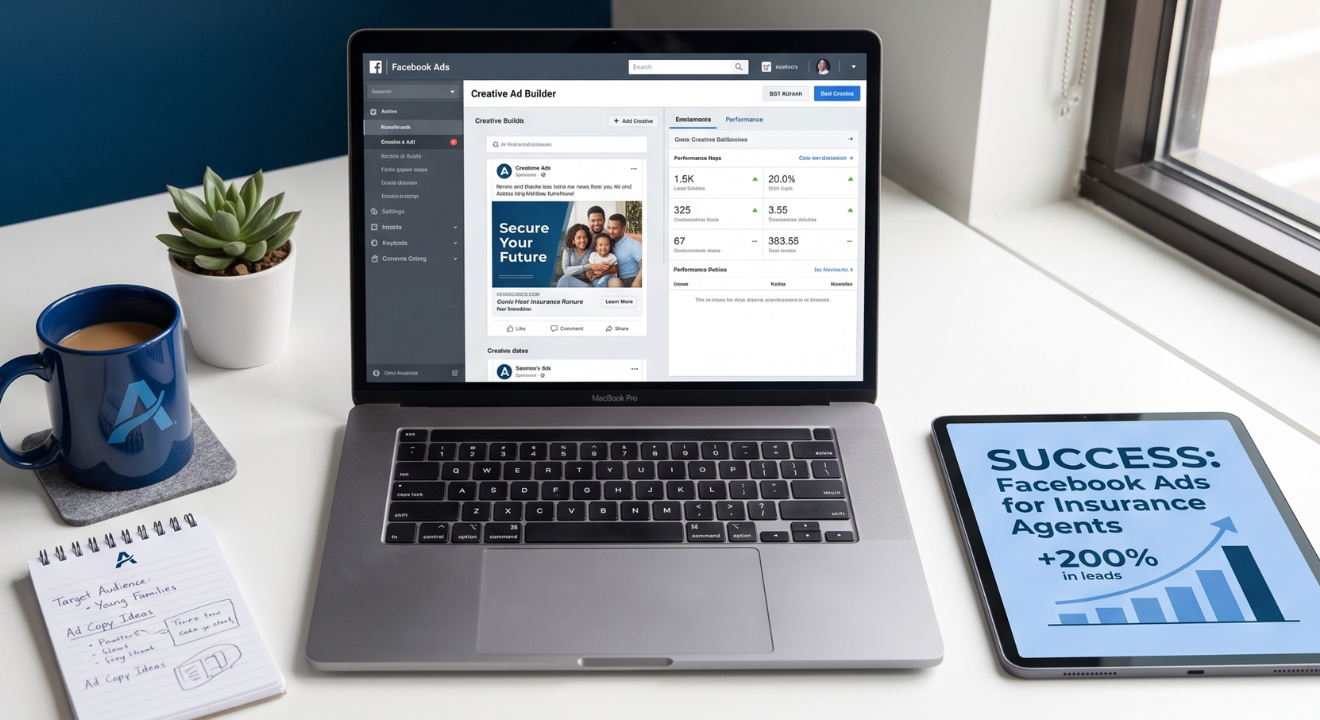
Digital advertising has become one of the most powerful lead generation tools available to insurance agencies today. Whether you sell auto, home, life, commercial, or Medicare coverage, platforms like Facebook and Google give you the ability to reach potential clients at scale — something that traditional marketing methods simply cannot match. For a comprehensive guide, check out this resource on digital marketing for insurance agencies.
The promise is real. With Facebook ads for insurance agents and Google ads for insurance agencies, you can target specific people in your area, track every dollar you spend, and measure results down to the cost per policy issued. Agencies running well-structured campaigns across multiple insurance lines are generating consistent, predictable flows of new business.
But here is where many agencies run into trouble.
Insurance is one of the most competitive and expensive advertising verticals on the internet. On Meta (Facebook and Instagram), the finance and insurance category carries the highest cost-per-click and the lowest click-through rate of any industry tracked in recent benchmarks. The average cost per lead across all industries on Facebook has risen roughly 21% year over year to around $27.66, while average conversion rates have dropped to 7.72%.
When you layer in Google Ads, U.S. insurance agencies are seeing cost-per-lead benchmarks of around $42 to $65, reflecting fierce competition on search. Even Facebook, which tends to be cheaper, is running $18 to $35 per lead for properly structured insurance campaigns.
The bottom line is this: without a clear strategy, proper tracking, and a solid follow-up system, your ad spend can disappear quickly without producing the results your agency needs. The difference between a campaign that drives profitable growth and one that drains your budget often comes down to how smart your approach is from the very beginning.
Running paid ads without a clear plan is one of the fastest ways to waste money in insurance marketing. Many agencies jump in with a generic campaign, set a daily budget, and hope for the best. The results are usually disappointing — and expensive.
A smarter approach starts with understanding that Google Ads and Facebook Ads serve very different roles in your marketing funnel. Learn more about understanding digital marketing for insurance agents.
Google Ads works by placing your agency in front of people who are actively searching for coverage right now. When someone types "auto insurance quote near me" or "Medicare supplement plan," they are already in buying mode. These searchers are closer to making a decision, which means your cost per lead may be higher, but your close rate will typically be much better.
This makes Google Ads a strong bottom-of-funnel channel — ideal for capturing demand that already exists.
For a visual explanation, watch this video on how Google Ads work.
Facebook Ads work differently. Most people scrolling through their feed are not actively thinking about insurance. But that does not mean they cannot become a lead. Facebook excels at reaching people who match your ideal buyer profile based on their life stage, interests, and behaviors — even before they start searching.
This makes Facebook a powerful top-of-funnel and nurturing tool. It is particularly effective for building brand awareness, growing your email list, and staying in front of prospects over time.
One of the most common mistakes agencies make is running a single broad campaign that tries to cover everything. Effective insurance PPC campaigns are broken down by line of business — separate campaigns for auto, home, life, and commercial insurance — and by region.
Your messaging also needs to match the platform. On social media, educational and emotionally driven content works best. On search, direct and benefit-focused copy converts better.
Without this level of campaign specificity, you end up with fragmented results, poor targeting, and no real way to know if your spend is profitable.
When done right, Facebook advertising for insurance can be a highly effective lead generation engine. But the platform has its own set of rules, best practices, and pitfalls that every agency needs to understand.
Meta data for the finance and insurance category shows a cost-per-click of around $4.57 for lead generation campaigns, with click-through rates averaging just 0.88% to 0.98% — the lowest of any tracked industry. That means you need strong creative and precise targeting to make your digital advertising for insurance work on this platform.
When campaigns are well-structured, specialist agencies report Facebook CPL for insurance falling between $18 and $35. With the right qualification steps and fast follow-up built in, lead-to-policy conversion rates can reach 20% to 35%.
Understanding and Using the Special Ad Category
Insurance advertising on Facebook falls under what Meta calls the Special Ad Category. This is an important rule that many agencies miss or ignore. When you run insurance lead generation ads, you must classify your campaign under this category.
What does this mean in practice?
Ignoring these rules does not mean you can run unconstrained campaigns — it means your ads will get rejected, flagged, or severely limited in reach.
Life Events and Interest-Based Targeting
Even within the restrictions of the Special Ad Category, there is a lot you can do. Facebook is especially powerful when you align your insurance ads with major life triggers that prompt people to seek coverage. These include:
Layering interest-based targeting — such as financial planning, homeownership, or small business topics — within the allowed rules can help you reach the right audience at the right moment.
Segmentation by Product Line
Your auto insurance audience is not the same as your life insurance audience. Running separate campaigns for each line of business, each with its own tailored messaging, dramatically improves performance. You should also build custom retargeting audiences for:
Go Video-First
For insurance, video ads consistently outperform static images — often by two to three times. Video gives you the space to build trust, address common objections, and connect emotionally with your audience. Strong formats include:
Lead with Emotion and Problem-Solution Storytelling
The most effective insurance ads on social media are not the ones that list policy features. They are the ones that speak to what your audience cares about most — protecting their family, achieving financial peace of mind, and securing their future. This aligns with advice on social media for insurance agents.
Research shows that emotionally driven content can perform roughly twice as well as purely rational messaging, with meaningful lifts in both engagement and profitability. For life insurance in particular, ads focused on family protection and financial security consistently outperform product-detail focused ads.
Qualify Leads Before They Click Through
One of the biggest drains on insurance ad budgets is generating a high volume of low-quality leads. Using Facebook's Higher Intent lead form option — which adds a review screen before the prospect submits — can reduce total lead volume by 20% to 30%, but improves lead quality by 40% to 60%. That trade-off is almost always worth it for insurance agencies.
You can also add qualifying questions directly in your form, such as "Do you currently own your home?" or "Who is your current insurance provider?" This filters out tire-kickers and saves your agents significant time.
If Facebook Ads are about creating demand, Google Ads are about capturing it. This is why Google ads for insurance agencies remain one of the most valuable paid advertising channels in the industry.
When a prospect types "home insurance quote near me" or "best Medicare supplement plan for seniors" into Google, they are signaling high intent. They are not just browsing — they are actively looking for a solution. Getting your agency in front of these searchers at that exact moment can lead to faster closes and stronger conversion rates than almost any other channel.
Yes, the cost-per-lead is higher on Google — typically $42 to $65 for insurance — but the quality of the leads and the speed at which they convert often makes the investment worthwhile.
Focus on Long-Tail, High-Intent Queries
Bidding on a single broad term like "insurance" is one of the most expensive mistakes you can make on Google. These head terms are dominated by major national carriers with enormous budgets, and the traffic is often low-intent.
Instead, build your campaigns around long-tail keywords that match exactly what your ideal client is searching for. For guidance, see our article on local SEO for insurance agents. Examples include:
These specific phrases attract people who are further along in their buying journey, which means better conversion rates and more efficient spend.
Use Exact Match and Build Strong Negative Keyword Lists
Many insurance agencies lose a significant portion of their Google Ads budget to irrelevant traffic. This happens when broad match keywords allow Google to show your ads for searches that have nothing to do with your services.
Using exact match for your core insurance keywords gives you tighter control over when your ads appear. Equally important is building a robust negative keyword list to block searches like:
Filtering out this irrelevant traffic can dramatically improve your return on ad spend.
When you are just starting out with Google Ads for insurance, it is generally safer to begin with manual cost-per-click bidding. This gives you more control while you gather data and understand which keywords and audiences are performing.
Once your campaigns have accumulated enough conversion data — typically at least 30 to 50 conversions per month — you can transition to automated bidding strategies like Target CPA or Target ROAS. These machine-learning tools can optimize your bids in real time, but they need sufficient data to work well. Rushing into automated bidding too early in a competitive vertical like insurance can lead to wasted spend.
Also keep seasonality in mind. Medicare and health insurance search costs spike sharply during enrollment periods. Adjusting your bids and budgets around these high-intent windows can give your agency a real competitive edge, as discussed in our insurance agency marketing plan for Q4.
Getting someone to click your ad is only half the battle. If they land on a page that feels generic, loads slowly, or does not match what the ad promised, they will leave without converting. This is crucial for insurance agency website design.
Your landing pages should:
Both platforms can generate leads and grow your agency. But they work best when you understand what each one does well — and when you use them together.
Feature | Google Ads | Facebook / Meta Ads
Primary role | High-intent, bottom-of-funnel acquisition | Awareness, list building, lead nurturing
Typical CPL (insurance) | $42 to $65 | $18 to $35 (properly structured)
Lead intent | Quote-ready, ready to talk now | Mixed intent, needs follow-up funnel
Ad format | Text-based search ads to landing page | Visual and video content, in-app lead forms
Targeting approach | Keywords and search intent | Life events, interests, demographics (limited)
The smartest insurance agencies do not treat Facebook and Google as competing channels. They treat them as two parts of a single, coordinated system.
Here is how the synergy works in practice:
Agencies that run this combined approach consistently report lower Google Ads CPL over a three to six month period, as pre-warmed audiences are more likely to click and convert.
A common budget allocation for mature accounts is around 70% to 80% on Google and 20% to 30% on Facebook, with adjustments based on which channel is producing the best consultation booking rates for each product line.
One of the most common reasons insurance agencies waste money on paid advertising is that they track the wrong things. Likes, impressions, and page views can feel reassuring, but they do not tell you whether your campaigns are actually growing your book of business.
Cost Per Lead (CPL): Track this by channel and by product line. A $30 CPL for auto insurance leads may be excellent, while the same number for a low-commission product might not pencil out.
Cost Per Issued Policy: This is arguably the most important number in your entire advertising program. It tells you the true cost of acquiring each new client, accounting for your close rate.
Conversion Rates at Every Stage of the Funnel:
Click-Through Rate (CTR) and CPC: These help you diagnose whether your creative and keyword choices are resonating with your audience.
Return on Ad Spend (ROAS): Measured as the premium or commission generated relative to what you spent on advertising.
Lead Quality Indicators: Contact rate, quote rate, and close rate per campaign tell you whether the leads you are generating are actually convertible — not just cheap.
To measure any of the above accurately, you need proper tracking infrastructure in place before you spend a single dollar on ads.
For Facebook, this means installing the Meta Pixel on your website and setting up conversion events that fire when someone submits a quote form or calls your agency.
For Google Ads, you need Google Analytics and Google Tag properly configured, with offline conversion tracking set up to import data from your CRM — so you can match policies issued back to specific keywords and campaigns.
Without this full-funnel tracking approach, you are essentially flying blind. You might know how many leads you generated, but you will not know which campaigns are actually producing profitable clients.
Finally, build regular campaign reviews into your process. Prune ads, audiences, and keywords that are not producing results. Reinvest that budget into the segments that are working. Small, ongoing optimizations compound over time into significantly better performance.
Compliance issues in insurance advertising are not just a legal concern — they are a strategic one. A campaign that violates platform policies or regulatory requirements can get your ads rejected, your account restricted, or worse, draw attention from your state insurance department.
Truthful and Non-Misleading Claims
Every insurance ad you run must be accurate. You cannot promise savings you cannot deliver, guarantee coverage that may not be available, or use misleading statistics to create a false impression of value. Where appropriate, clearly disclose policy limits, exclusions, and any conditions that apply.
Proper Agency Identification and Licensing
Most regulatory frameworks require that ads identify the licensed agency or insurer behind the promotion. This often means including your agency name, license number, and noting which states you are licensed in — particularly for products like Medicare supplements or life insurance where state-specific rules apply.
Special Ad Category Compliance on Meta
As covered earlier, insurance ads on Facebook must be classified under the Special Ad Category for financial products and services, as highlighted in our social media tips for insurance agencies. Failing to do this properly leads to rejected campaigns and potential account-level restrictions. Respecting the targeting limitations that come with this category is not optional — it is required.
Data Privacy and Lead Handling
Your lead capture forms and landing pages need to comply with data privacy requirements. This means clearly telling prospects how their information will be used and who will contact them. Avoid collecting sensitive personal data directly through ad platform lead forms unless it is truly necessary for your process.
Non-compliance in insurance advertising can lead to immediate ad disapproval, account suspension, and potential regulatory scrutiny. Treating compliance as a strategic priority — not an afterthought — protects both your ad accounts and your agency's reputation.
Running effective Facebook and Google Ads for insurance requires a level of expertise, technical setup, and ongoing attention that most agency owners simply do not have the bandwidth for. That is where Kusanku Marketing Solutions comes in.
Kusanku is a client-focused marketing partner built specifically to help insurance agencies turn their paid advertising into a reliable, profitable growth channel. Here is what that looks like in practice.
Before a single ad goes live, Kusanku works with you to define your buyer personas, clarify which lines of business to prioritize, and determine the right budget allocation between Google and Facebook based on your specific goals. This means your campaigns are built with a clear purpose from day one — not adjusted later after wasted spend.
Kusanku handles the full technical setup and ongoing management of both your Google Ads accounts and your Facebook campaigns. This includes:
Kusanku does not just track clicks. The team connects your Meta Pixel and Google Tags to your CRM and tracks performance all the way to cost per issued policy. Automated follow-up sequences are built to prevent lead decay, ensuring that the leads your ads generate actually reach your agents quickly and efficiently.
Kusanku also provides compliance-aware creative consulting, helping you develop ad copy and visuals that are both persuasive and fully compliant with insurance advertising regulations. Emotionally resonant, benefit-driven messaging is developed with proper disclosures built in — so your ads get approved, stay live, and connect with the right audience.
The opportunity in Facebook ads for insurance agents and Google ads for insurance agencies has never been greater. But so has the competition. Agencies that approach paid digital advertising with a clear strategy, proper tracking infrastructure, compliant creative, and fast lead follow-up are the ones building sustainable, scalable growth.
Those that run generic campaigns without structure are burning through budget with little to show for it.
The most effective approach is a dual-platform strategy that uses Google to capture high-intent demand and Facebook to build awareness, nurture prospects, and support retargeting. Together, these channels create a full-funnel marketing system that is more powerful than either platform alone.
But none of it works without continuous monitoring, regular optimization, and a willingness to adjust your approach as costs and competition evolve. The insurance advertising landscape changes — and your strategy needs to change with it.
If your agency is ready to stop guessing and start building a paid advertising program that actually delivers profitable new clients, the right partner makes all the difference.
A prospect may be asking ChatGPT for an insurance agency right now. We'll show you what it says about you — and who it's recommending instead.


No cost, no obligation · Delivered in 3 business days · Prepared by Lee
We'll check what ChatGPT, Google AI, Perplexity, and Gemini say about you — and who they're recommending instead. Free, and yours in 3 business days.
Insurance is one of the most competitive advertising verticals online. High demand from numerous agencies and national carriers drives up bid prices, especially for high-intent keywords and audiences.
The most effective strategy typically involves using both platforms. Google Ads capture existing high-intent demand, while Facebook Ads build awareness and nurture leads higher up the funnel. A coordinated approach leverages the strengths of both.
The Special Ad Category is a Meta (Facebook) requirement for ads related to financial services, employment, housing, or credit. For insurance ads, it imposes restrictions on detailed targeting (e.g., age, hyper-local geography) to prevent discrimination. Non-compliance leads to rejected ads and potential account issues.
On Facebook, use Higher Intent lead forms and add qualifying questions directly into your forms. On Google, focus on long-tail, specific keywords and a robust negative keyword list to attract more relevant searchers. Ensure your landing pages provide clear, relevant information and easy conversion paths.
Beyond clicks and impressions, focus on Cost Per Lead (CPL), Cost Per Issued Policy, and conversion rates at every stage of your sales funnel (e.g., lead-to-appointment, appointment-to-policy). Also track your Return on Ad Spend (ROAS) to ensure profitability. This requires proper tracking setup linking your ad platforms to your CRM.
Bought leads are the only asset in your agency that disappears the month you stop paying for it. Everything else in this guide, you keep.
Download Free


