
Unlock the future of insurance marketing! Discover how Answer Engine Optimization (AEO) is revolutionizing the way potential clients find your agency through AI searches. In this guide, learn practical strategies to ensure your agency stands out as a top recommendation in an era where AI is reshaping customer decision-making. Don’t miss out—make sure your agency is on the radar!
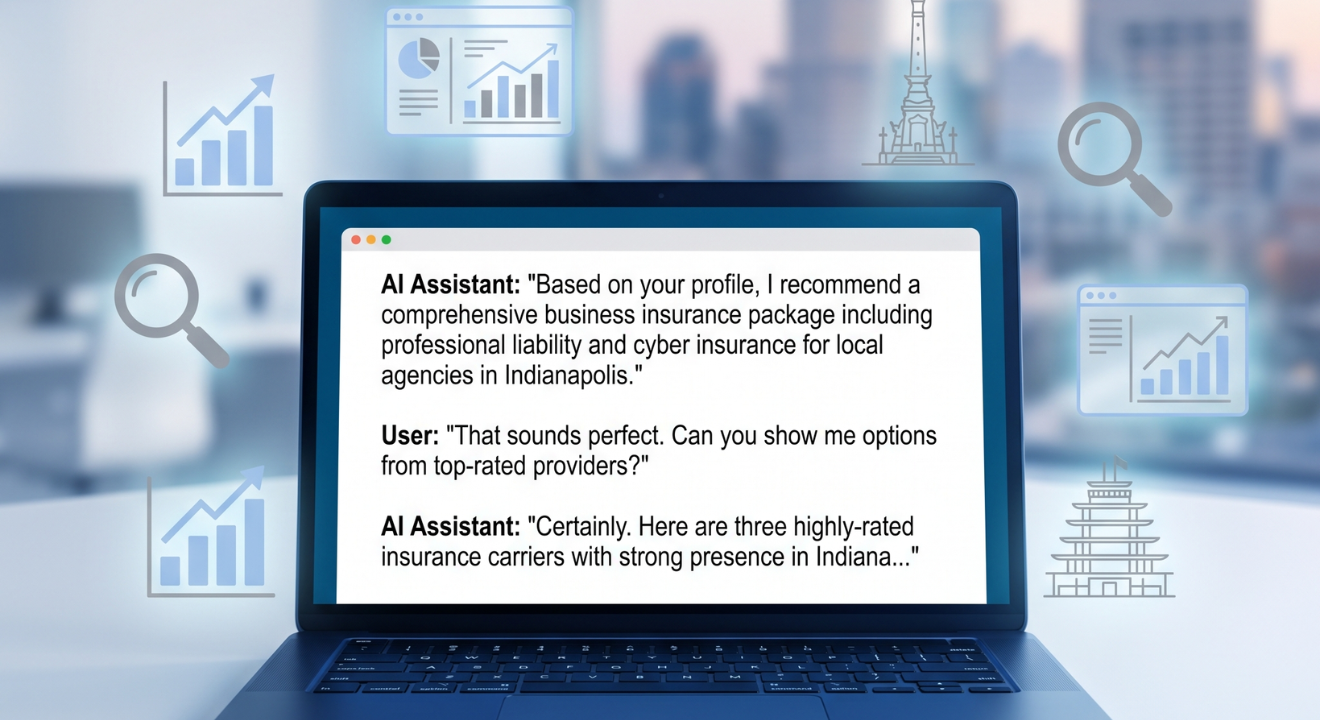
Think about the last time someone in your community needed home insurance after buying a new property. A few years ago, they would have typed "home insurance agency near me" into Google and scrolled through a list of links. Today, they are just as likely to open ChatGPT, Gemini, or Google's AI Overview and ask: "What should I look for in a home insurance agency?" or "Which insurance agency serves families in [their town]?"
The answer they get back is not a list of ten blue links. It is a direct, conversational response. And if your agency is not mentioned in that response, you simply do not exist for that prospect in that moment.
This is not a distant possibility. It is happening right now. AI search optimization for insurance is becoming one of the most important topics for agency principals to understand, and the question "will AI recommend my agency?" is one you should be asking yourself today.
The good news is that there is a clear, practical approach to improving your chances of being cited, mentioned, and recommended by AI systems. It is called Answer Engine Optimization, or AEO. And this guide will walk you through exactly what it is, why it matters, and what you can do about it.
AEO for insurance agencies is the process of making your website and business information easy for AI systems to read, understand, and use when answering insurance questions on behalf of a user.
In simple terms, it means organizing your content so that when someone asks an AI tool a question about insurance, your agency's information is clear enough, structured enough, and trustworthy enough to be selected as part of the answer.
Traditional search engine optimization, or SEO, focused on getting your web pages to rank highly in a list of search results. AEO is different. AEO aims to make your content the actual answer, not just a link that might get clicked.
Think of it this way:
Both SEO and AEO matter for your agency's digital presence. But they serve different purposes in today's search environment, and it helps to understand exactly how they are different.
SEO is the practice of making your website rank well in traditional search results. It involves things like using the right keywords, earning backlinks from other websites, improving your page speed, and creating helpful content. When done well, SEO puts your agency's website on the first page of Google when someone searches for insurance services.
AEO, or answer engine optimization, goes a step further. It is about making your content clear enough and structured enough that AI systems can pull information directly from it and present it as a trusted answer. Nationwide's insurance marketing guidance puts it well: SEO gets you found, while AEO gets you cited in AI overviews and into a prospect's early consideration set.
Here is a practical example. Imagine a prospect types into ChatGPT: "What does umbrella insurance cover and do I need it as a small business owner?" An SEO-optimized page might rank well in Google for that phrase. But if your content is not structured in a way that AI can easily interpret and quote, you will not appear in the AI's response. A competitor whose content is clearly organized, question-led, and detailed may be the agency that gets recommended instead.
AI tools including ChatGPT, Gemini, Microsoft Copilot, Perplexity, and Google AI Overview are designed to synthesize multiple sources into a single, helpful response. They reward content that is easy to parse, clearly organized, and directly responsive to a user's question. Vague, thin, or difficult-to-read content is far less likely to be surfaced by these systems.
This is where the shift becomes very real for agencies.
When someone searches Google in the traditional way, they see a ranked list of pages. They might see ten results, scan the headlines, and click on one or two that look relevant. Your agency has multiple chances to earn that click.
When someone uses an AI-powered search tool or assistant, they often receive a single synthesized response. The AI has already read, evaluated, and summarized information from multiple sources. The user does not need to click through to a website unless they want more detail. Your agency is either mentioned in that response, or it is not.
In insurance, AI answers tend to be shaped by very specific types of content:
If your website only has a generic "About Us" page and a contact form, AI systems have very little to work with. But if your site includes detailed coverage pages, a well-built FAQ section, and consistent local information, AI tools have structured, reliable content they can confidently use in a response.
AEO for insurance agencies is not a cutting-edge experiment reserved for large carriers or tech-savvy marketing teams. It is quickly becoming a competitive necessity for every independent agency that wants to stay visible as search behavior evolves.
Here is the hard truth: you can have a beautifully designed website, a solid SEO track record, and years of five-star reviews, and still be completely invisible in AI-generated answers if your content is not structured in a way that AI can interpret.
Agencies that do not provide machine-readable, well-organized information risk being overlooked even if they have a strong traditional online presence. Meanwhile, a smaller competitor with a well-structured FAQ page, dedicated coverage pages, and clear local information could be the one that gets recommended to your next potential client.
The question "will AI recommend my agency?" is not just a curiosity. It is a real business question with real revenue implications.
When an AI tool recommends a competitor or cites a competitor's explanation first, that agency enters the prospect's shortlist before you even have a chance to make an impression. Insurance buyers are making faster decisions than ever, and AI is accelerating that process.
Nationwide's guidance on insurance digital marketing makes this point directly: search funnels are collapsing. What used to be a multi-day journey from awareness to quote can now happen in a single AI-assisted session. If your agency is not present at the beginning of that session, you may never get a chance to enter the conversation at all. The ability to get recommended by ChatGPT and similar tools is becoming an early-funnel advantage that compounds over time.
AI systems are particularly careful in topic areas that involve money, legal matters, health, and safety. Insurance falls squarely into this category. These systems favor content that demonstrates authority, clarity, and consistency, especially when the topic involves financial protection and risk management.
This is actually good news for agencies that take their content seriously. If you publish clear, accurate, well-organized information about the coverage options you offer, the carriers you work with, and the community you serve, you are already speaking the language that AI systems are looking for.
Independent agencies have something that national carriers and aggregator websites often lack: deep local knowledge and specialized expertise. AEO guidance aimed at insurance agencies consistently emphasizes that local authority, specific coverage pages, and answers built around real client questions are among the strongest signals AI systems look for.
If you specialize in farm coverage, contractor liability, or coastal property insurance, that niche expertise is highly valuable in insurance agency AI search contexts. AI tools are looking for sources that can answer specific, high-intent questions with real depth. Your years of experience in a particular community or coverage area can become a direct competitive advantage when it is clearly presented on your website.
FAQs, dedicated coverage pages, how-it-works explanations, and insurance glossary entries give AI systems modular, easy-to-cite pieces of information. This type of content is not just helpful for prospects, it is exactly what AI tools are trained to look for and use.
Insurance agencies are actually a very strong fit for AEO because customers ask precise, high-intent questions before buying. Questions like "Does renters insurance cover my laptop?" or "How much business liability coverage does a contractor need?" are the kinds of queries that AI tools field every day. If your website answers those questions clearly and accurately, you are a natural candidate for citation.
Getting started with AEO does not require a full website rebuild or a big marketing budget. It starts with making intentional changes to how your information is organized and presented. Here are concrete steps you can take:
Build dedicated pages for each major line of business.
Do not rely on a single "Insurance Services" page to cover everything. Create individual pages for home insurance, auto insurance, business insurance, life insurance, and any specialty lines you offer. Each page should explain what the coverage is, who it is for, what it typically includes, and what questions prospects commonly ask.
Add a thorough FAQ section.
FAQs are one of the most powerful AEO tools available because they directly mirror how people phrase questions to AI systems. Think about the questions your clients and prospects ask you most often. Write clear, direct answers in plain English. AI tools love well-organized, question-and-answer formatted content.
Make your agency identity crystal clear.
AI systems need to understand who you are. Make it obvious on your website that you are an independent agency (or captive, if that applies), which carriers you work with, which geographic areas you serve, and what types of clients you specialize in helping. Ambiguity is the enemy of AI visibility.
Keep your business information consistent everywhere.
Your agency name, address, phone number, and service details should be identical across your website, Google Business Profile, Yelp, industry directories, and any other platform where you appear. AI systems use this consistency as a trust signal when deciding whether to cite your agency.
Earn and respond to reviews.
Reviews are part of the trust ecosystem that AI systems evaluate. Encourage satisfied clients to leave reviews on Google and other platforms, and respond to those reviews professionally. Consistent, positive feedback across platforms reinforces your agency's credibility in the eyes of AI tools. Social proof is powerful.
One of the most important mindset shifts for agency principals to make is understanding that AEO is not simply about inserting the right keywords into your content. It is about structuring information so that AI systems can interpret it clearly and trust it enough to use.
Think of your website content as a briefing document. If an AI system were a very efficient research assistant reading your website at high speed, would it walk away with a clear, accurate picture of exactly who you are, what you offer, which areas you serve, and why a prospect should trust you? If the answer is anything less than a confident yes, there is work to be done.
AEO is about machine readability and answerability. Every page on your website is an opportunity to provide AI tools with clean, confident, authoritative information that they can use to represent your agency well.
There is one more reason to take AEO seriously right now: the buyer's journey in insurance is compressing.
Prospects used to move through a longer process. They would become aware of a need, research options over several days, visit multiple websites, maybe ask friends for referrals, and then reach out to an agency. AI is collapsing that timeline. A prospect can go from asking a question to reading an AI-generated recommendation to booking a consultation in a single sitting.
If your agency is cited in the AI response that starts that journey, you have a real chance of being contacted. If you are not, that prospect may never discover you at all, regardless of how good your actual service is.
The way prospects discover insurance agencies is shifting in a fundamental way. AI search optimization for insurance is moving from an optional upgrade to a core part of any serious agency marketing strategy.
AEO for insurance agencies is the discipline that bridges the gap between a well-run agency and a well-represented agency in the age of AI. It helps AI tools understand exactly who you are, what you cover, who you serve, and why you are a credible source of help. When that understanding is in place, AI systems are far more likely to mention, cite, and recommend your agency when a prospect asks for help.
The agencies that adapt early will have a meaningful head start. They will be the ones appearing in AI-generated answers while competitors are still wondering why their phone is not ringing.
Here is your simple starting point:
Answer engine optimization is not about gaming a system. It is about being genuinely useful, clearly organized, and consistently trustworthy across every digital touchpoint. That is exactly the kind of agency that AI will recommend and exactly the kind of agency your clients deserve.
A prospect may be asking ChatGPT for an insurance agency right now. We'll show you what it says about you — and who it's recommending instead.


No cost, no obligation · Delivered in 3 business days · Prepared by Lee
We'll check what ChatGPT, Google AI, Perplexity, and Gemini say about you — and who they're recommending instead. Free, and yours in 3 business days.
AEO (Answer Engine Optimization) focuses on structuring your content so AI systems can directly use it to answer user questions, making your agency part of the AI's direct response. SEO (Search Engine Optimization) aims to rank your website high in traditional search results (lists of links). While SEO helps people find you, AEO helps AI understand and recommend you.
Like SEO, AEO is a long-game strategy, not an overnight switch. As your content, listings, and reputation strengthen, you'll gradually become a more likely answer. Agencies that start now build a lead that's hard for latecomers to close.
AI tools like ChatGPT and Google's AI Overview are changing how people search. If your agency's information isn't easily digestible by AI, you risk being invisible. AEO ensures your agency is cited and recommended in these AI-generated responses, giving you a crucial advantage in the early stages of a prospect's buying journey.
Prioritize content that is clear, structured, and directly answers common questions. This includes dedicated pages for each insurance product you offer, comprehensive FAQ sections, and detailed local information about your service areas and specializations. Ensure your general business information (NAP: Name, Address, Phone) is consistent across all online platforms.
Absolutely! Independent agencies often have deep local knowledge and niche expertise that large carriers lack. By clearly articulating this local authority and specialized coverage on your website, you can become a highly credible source for AI systems looking to answer specific, granular questions. This expertise is a significant competitive advantage in the AEO landscape.
Bought leads are the only asset in your agency that disappears the month you stop paying for it. Everything else in this guide, you keep.
Download Free


